Somewhere in Chapter 6 Is a Number You Can No Longer Source.
A non-fiction book goes wrong in its evidence: a figure copied in March with no source beside it, a quotation you’d swear was from Sontag, a link that has since died. Shiro is non-fiction book writing software that keeps your sources, your claims and your draft in one project, and can show you what still needs checking.
Where the Trouble Starts
You read something in March. It’s exactly right, so you paste the number into the draft, promising yourself you’ll add the reference later. By October you have 90,000 words, a publisher’s fact-checking query, and a browser history with no memory of March.
Most of the danger in a non-fiction book is in that gap between the sentence and what it rests on. Tools that keep references in one program and prose in another make the gap wider, however good each program is on its own.
Sources Next to the Sentence
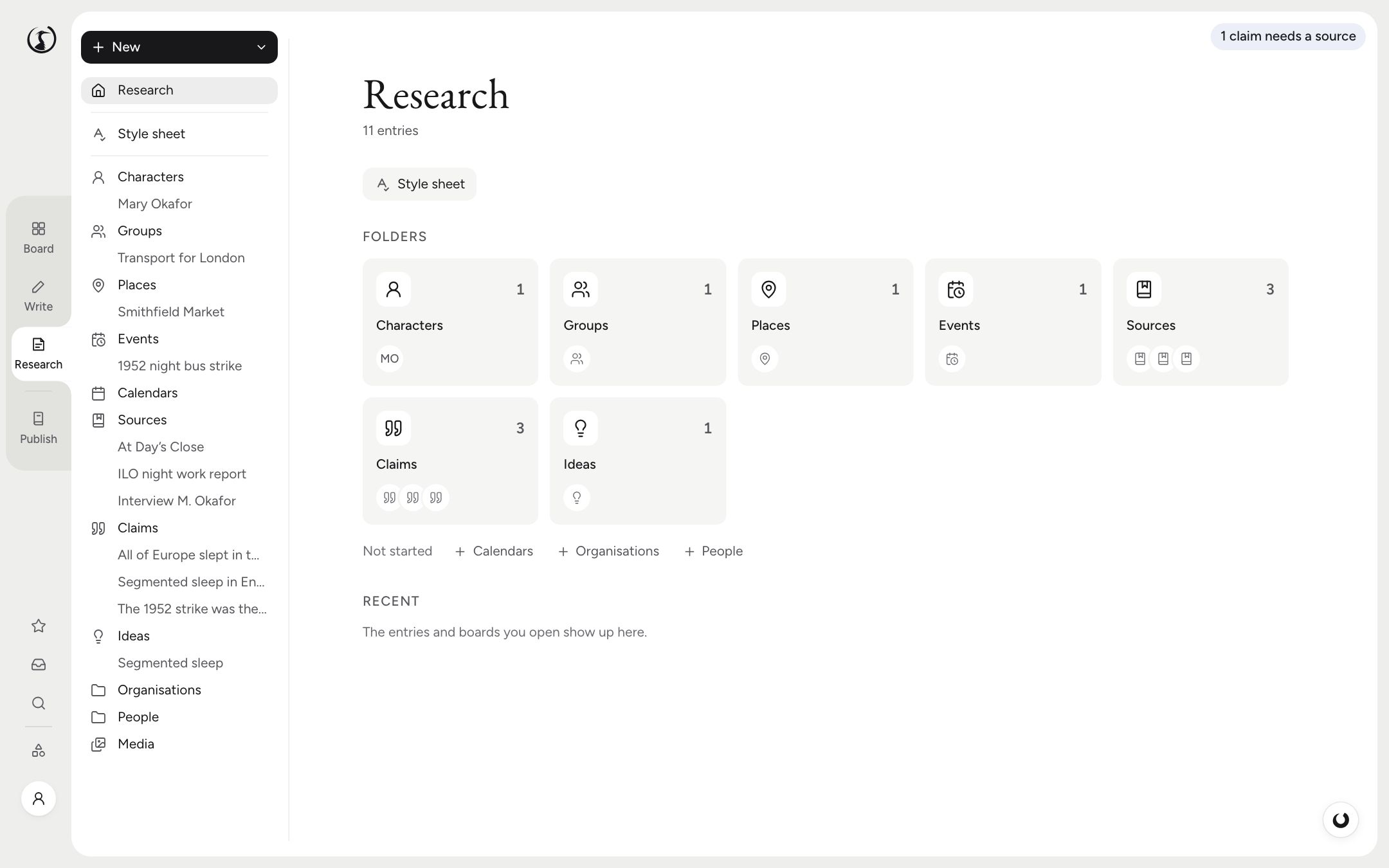
The Research lens is where your sources live. Read a PDF inside the app, highlight in four colours, drag a highlight into your text, and it arrives as a quotation with its citation. Look up a DOI or an ISBN when you ask to, and import from BibTeX, RIS or CSL JSON. For a web page, keep a copy of it as it looked on the day you read it. Links die, and the one you most needed tends to die first.
Each source shows how many times it’s cited and where. Citations use Chicago notes, Chicago author-date, APA, MLA or Harvard, and the bibliography comes out with the book.
Claims, in a List You Can’t Avoid
A claim is a statement your book depends on, kept as its own entry, with a status: verified, disputed or needs a source. Research keeps the running total, “3 claims need a source”, until it can say that every claim has one.
New non-fiction projects begin with these revision passes: structure, argument, clarity, fact check, line and proof. The fact check pass comes with a checklist: every figure and date has a source, quotes match word for word, names and titles are right, and open claims are resolved. It’s dull work, and it’s the work that gets the book reviewed for its argument and not for the error in chapter 6.
If you use the AI for research, treat what it says as a lead. Language models can invent a citation with perfect composure. Mark a claim as verified when you’ve held the source in your hands.
The Proposal, Before the Book
Many non-fiction books sell on a proposal, so there’s a process for one on your Board. Book proposal goes through the overview (what is the book about in one sentence, and why now), readers and market (who buys it, and which three books sit beside it on the shelf), about the author (who already listens to you, a question nobody enjoys), a chapter outline, and a sample chapter of about 5,000 words, which goes straight into the manuscript, so it isn’t wasted if the answer is yes.
An Argument Can Be Moved Around
A section in Shiro is a card on the Board, so when chapter 4 turns out to be making chapter 9’s point, you can move the sections and see the structure again. Templates cover how-to books and theses, and the writing tools include footnotes, tables, attributed quotes and callouts. A print index comes with Publish.
Where Another Tool Suits You Better
If your publisher or institution needs a citation style outside those five, Shiro can’t load a custom CSL file. If you work in LaTeX, Scrivener reaches it through Pandoc or MultiMarkdown and has a long record with big research-heavy books. And if your library lives in Zotero and you like it there, Shiro’s Zotero plugin is only an example so far, so check it does what you need before moving.
The Questions People Ask
Which citation styles does Shiro support?
Chicago notes and bibliography, Chicago author-date, APA, MLA and Harvard, in Pandoc-style citations. You can’t load a custom CSL file, so if your publisher has its own house style, check first.
Can I bring in my existing references?
Yes. Shiro imports BibTeX, RIS and CSL JSON, and can look up details from a DOI or ISBN when you ask it to. Zotero exists as an example plugin.
Does Shiro help with a book proposal?
Yes. A Book proposal process walks through the overview, readers and market, about the author, a chapter outline and a sample chapter, which goes into the manuscript.
Is it suitable for a thesis?
There’s a thesis template among the project templates, and footnotes, tables and citations work as in any other project. Check the citation style your institution requires against the five that Shiro has.