You Invented the Calendar. Now You Have to Live in It.
Fantasy and science fiction tend to go wrong in the paperwork: a month you named and forgot, a spell that stops costing anything around page 300, a road that takes six days until the plot needs it to take two. Shiro keeps your maps, calendars, languages and magic rules in the same project as the draft, and can check one against the other.
Two Ways to Lose a Fantasy Novel
The first is the wiki. Eleven years and four hundred pages on the grain trade of the southern provinces, and no chapter one. The second is to write straight into the dark and discover at the end that the queen’s age, the width of the river and the entire theory of magic have each changed three times.
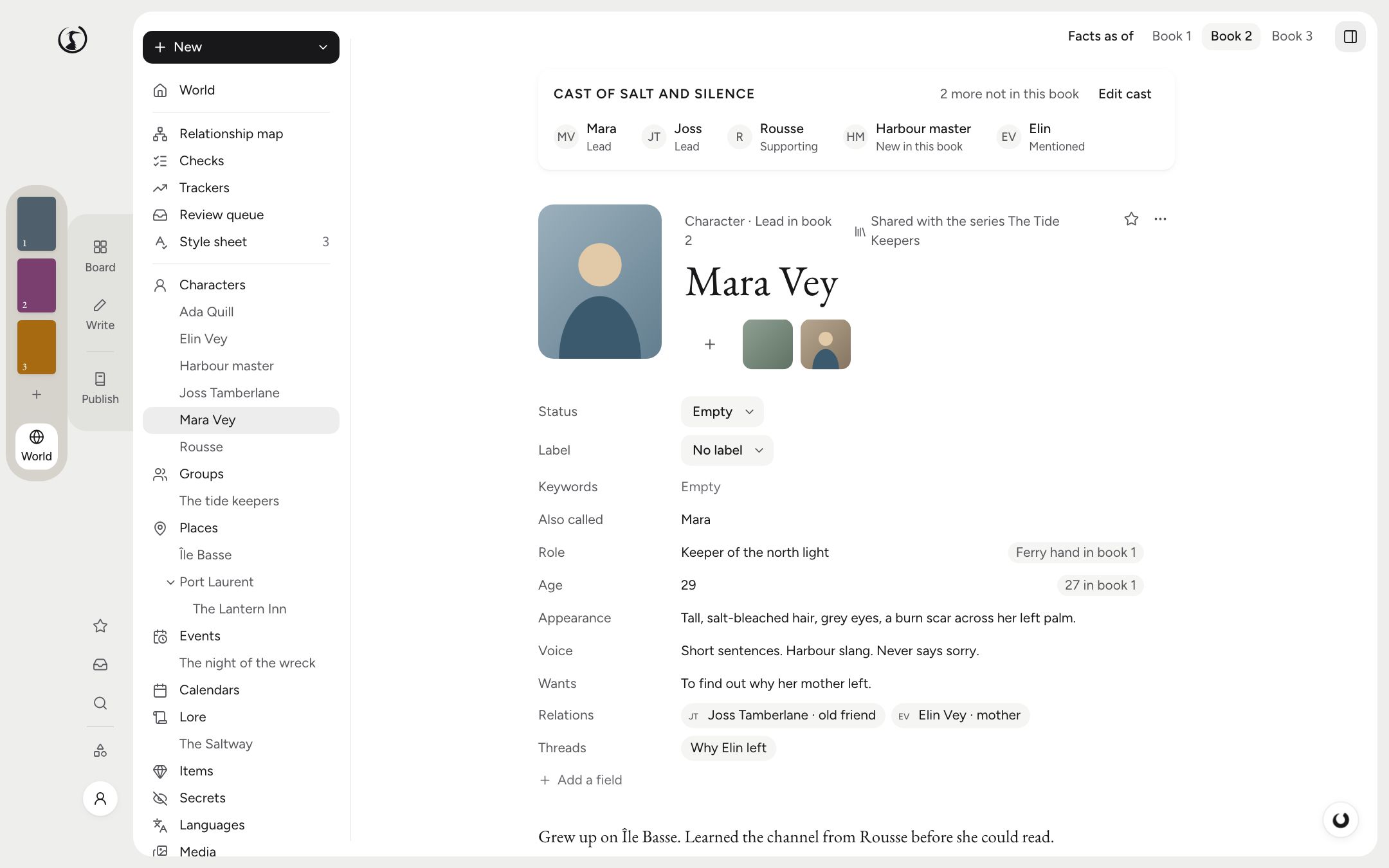
A world-building app kept apart from the manuscript doesn’t solve either one, because it goes out of date the first time the draft surprises you. In Shiro, the World and the book are one project. Entries connect to the scenes that name them, so opening Kethra shows every scene she’s in, including the two where you called her Kethrin. Add that as an alias.
Maps That Notice the Road Was Too Short
Shiro doesn’t draw your map. You bring the image, and give it a scale, pins, zones and routes. Say how far someone travels in a day along each kind of route, on foot, by river, by ship, and the travel-time check compares each journey with the time your scenes allow.
So when the cavalry reaches the pass in two days and the map says six, you hear about it. The check has no opinion on the fact that the battle needs them there by the 14th. That one’s yours to solve.
A Calendar With Moons That Keep Their Appointments
A calendar entry takes months of any length, weeks, leap years with your own rule, eras (including one that counts backwards), moons, seasons and the way dates are written. Make it the book’s calendar, and the Timeline, ages and durations run on it as they would on ordinary dates. The month grid shows the moon’s phase, so you can look up whether anything could really have changed into a wolf on the 14th of Harrowmonth.
Languages, Without Nine Hundred Red Underlines
A language entry holds a lexicon with parts of speech, notes on grammar, and sample sentences whose word-by-word gloss comes from the lexicon. Its words feed the style sheet, which the spellchecker reads, so your invented city stops being a typo. You can mark a passage as written in that language and check it against the lexicon, for the day your elves’ word for river quietly changes.
Magic, and What It Costs
Hard magic systems tend to fail by inflation: the spell that took a year off the caster’s life on page 40 is free by page 400, because the plot was in a hurry. A lore entry has fields for the rule, its limits, its costs and examples. Trackers follow resources, wounds, knowledge and possessions across scenes.
The continuity checks are code, and you can add your own from templates: only goes down, stays within limits, known before used, revealed in order, never together. If you use the AI, the World rules check also reads the scenes that name an entry and reports passages that break its rule, when you ask.
Facts That Change While the Story Runs
Aric is a squire in chapter 2, a knight in chapter 20 and a one-armed knight by chapter 31. Record the change in the scene where it happens and the World shows each fact as it stands at any point in the story. Across several books, later facts hide while you write the earlier ones, which the series page explains.
When to Use Something Else
If building the world is the pleasure in itself, have a look at Campfire, whose modules include species, cultures and magic systems and which has a free tier. Shiro’s World is there to serve a manuscript. It has custom kinds for your species and cultures, but it was built on the assumption that you’re eventually going to write chapter one.
The Questions People Ask
Can Shiro use my own invented calendar?
Yes. A calendar entry takes months of any length, weeks, leap-year rules, eras that count forwards or backwards, moons, seasons and date formats. Make it the book’s calendar and the Timeline, ages, durations and checks all work in it.
Does Shiro draw maps?
No. You bring the image, from a mapmaking app or a scan of your own drawing. Shiro adds pins, zones, routes and a scale on top, and uses them to measure distances and check journeys.
Do the checks need AI?
The built-in checks don’t. One place at a time, travel time, reveal order and the checks you add yourself are code that reads your scene details. Only the World rules check, which reads your prose against a written rule, needs a model.
Does it work for science fiction?
Yes. The tools are the same, and there are project templates for fantasy, romantasy and science fiction. A colony’s 410-day year is just another calendar.